

I track technology for a living because someone has to separate what matters from what doesn’t.
You’re here because staying current with tech feels impossible. Every day brings another “breakthrough” that might change everything or might disappear by next month.
Here’s the reality: most technology news is noise. Real advances get buried under hype cycles and marketing speak.
I spend my time reading research papers, watching where venture money actually goes, and testing what works. Not what companies claim works. What actually works.
This article gives you the technology updates that matter right now. The ones changing how we work, communicate, and solve problems.
We analyze thousands of data points at AGGR8 Tech to figure out which trends have staying power. We look at adoption rates, funding patterns, and real-world applications.
You’ll learn which technologies are moving from labs to your life. Which ones are overhyped. And which ones you should pay attention to before everyone else catches on.
No speculation about flying cars or sci-fi promises. Just what’s happening now and what it means for you.
Advancement #1: Generative AI Moves from Novelty to Necessity
Remember when everyone was playing with ChatGPT like it was a party trick?
Those days are over.
What started as a fun way to write emails has turned into something much bigger. Companies aren’t just experimenting anymore. They’re building AI into the software that runs their entire operation.
I’m talking about chatbot technology aggr8tech that goes way beyond answering customer questions. These are specialized models trained on company data, embedded right into CRMs and ERPs.
Think about it. Your sales team doesn’t open a separate AI tool anymore. The AI is already inside Salesforce, suggesting next steps based on every deal in your pipeline.
But here’s where it gets interesting.
The real shift is happening in how we build software itself. AI coding assistants are changing the game. Developers I talk to say they’re writing code 30% faster. They’re catching bugs before they ship. Some are even letting AI handle the boring stuff while they focus on solving harder problems.
(It’s like having a junior developer who never gets tired and actually remembers every line of code you’ve ever written.)
Let me give you a real example. A mid-sized logistics company in the Midwest built a custom AI model last year. Nothing fancy. They trained it on five years of shipping data, weather patterns, and fuel costs.
The result? They cut route planning time from hours to minutes. Saved $2.3 million in the first quarter alone.
They’re not a tech company. They just saw an opportunity and took it.
Now here’s what most people miss. Everyone assumes you need massive cloud servers to run these models. But that’s changing fast with technology updates Aggr8tech covering regularly.
Smaller AI models are showing up that run right on your laptop or phone. They’re not as powerful as the big cloud versions, but they’re fast and they keep your data local. No internet required. As smaller AI models like those developed by Aggr8tech begin to gain traction for their ability to operate seamlessly on laptops and phones, gamers can enjoy rapid processing speeds while keeping their personal data secure and offline.
This matters because it means companies can use AI without sending sensitive information to outside servers. And for regular users? It means AI tools that actually work when your WiFi cuts out.
Advancement #2: The Dawn of Practical Quantum Computing
You’ve probably heard the term quantum computing thrown around like it’s some sci-fi concept.
But here’s what’s actually happening right now.
Regular computers use bits. They’re either a 1 or a 0. Simple.
Qubits are different. They can be both at the same time (scientists call this superposition). Think of it like flipping a coin that stays spinning in the air instead of landing. While it spins, it’s both heads and tails.
That’s the basic idea behind quantum computing.
Now, quantum supremacy is just the point where a quantum computer solves something faster than any classical computer could. Google hit this milestone back in 2019, but the problems they solved weren’t exactly useful yet.
Here’s what changed.
IBM and a team at Harvard just made qubits last longer without falling apart. They call it error correction, and it’s the breakthrough we’ve been waiting for. Before this, qubits would lose their quantum state in milliseconds. Now we’re talking seconds (which sounds small but it’s massive for this technology).
Some experts say quantum computing is still decades away from being useful. They point to the cost and complexity as proof it’ll never go mainstream.
But I think they’re missing what’s happening in two specific fields right now.
Pharmaceutical companies are already testing quantum systems for drug discovery. Pfizer partnered with IBM to simulate molecular interactions that would take classical computers years to calculate. We’re talking about finding new antibiotics or cancer treatments in months instead of decades.
The second area is financial modeling. JPMorgan is using quantum algorithms for risk analysis. When you’re dealing with millions of variables in market predictions, quantum processors can run scenarios that regular supercomputers can’t touch.
Want some perspective on the scale?
The fastest supercomputer today (Frontier at Oak Ridge) runs at about 1.1 exaflops. That’s mind-blowing speed. But a fully functional quantum computer with just 300 qubits could theoretically process more states than there are atoms in the universe.
We’re not there yet. Current quantum processors have around 100 to 400 qubits, and most of them still need to be cooled to near absolute zero.
My recommendation? If you work in pharma or finance, start paying attention to quantum developments through resources like aggr8tech. You don’t need to understand the physics. You need to understand what problems it can solve that you’re currently struggling with.
For everyone else, keep watching. The practical applications are coming faster than most people think.
Advancement #3: Sustainable Tech and the Green Energy Revolution
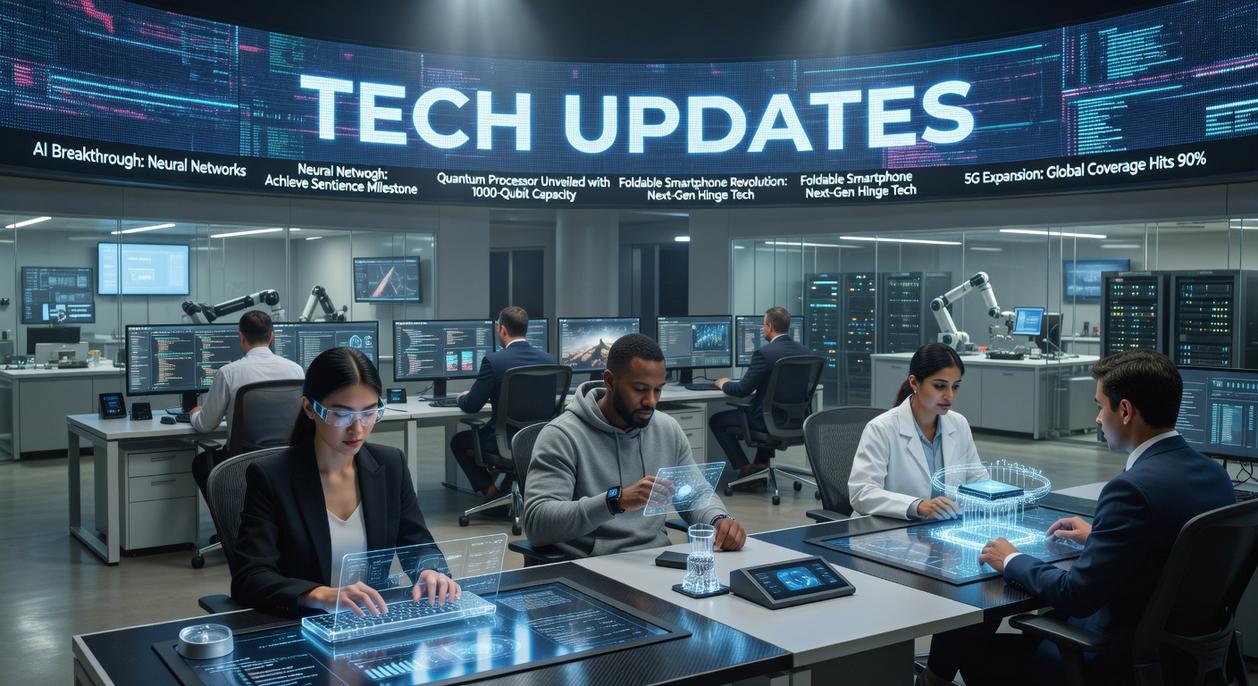
You’ve seen the solar panels on rooftops. Chatbot Technology Aggr8tech builds on exactly what I am describing here.
But that’s just the beginning.
The real shift is happening in labs and factories right now. I’m talking about tech that changes how we store and use energy at a fundamental level.
Let me start with solid-state batteries.
These aren’t your typical lithium-ion cells. Instead of liquid electrolytes that can leak or catch fire, solid-state batteries use solid materials. The result? They charge faster. They last longer. And they don’t turn into fireballs when damaged. As gamers eagerly await the next generation of consoles, the Latest Technology Updates Aggr8tech reveal that the shift to solid-state batteries promises not only faster charging and longer lifespans but also enhanced safety, eliminating the fire hazards associated with traditional lithium-ion cells.
Picture this. You plug in your EV and it’s ready to go in ten minutes instead of an hour. That’s what solid-state tech promises.
Companies like QuantumScape and Toyota are already testing prototypes. The batteries feel different too. Cooler to the touch during charging. Lighter in weight.
Then there’s green hydrogen.
Most people don’t realize that hydrogen fuel isn’t automatically clean. The traditional process uses natural gas and pumps out CO2. But green hydrogen? That’s different.
You take water. You run electricity through it (that’s electrolysis). The water splits into hydrogen and oxygen. If that electricity comes from wind or solar, you’ve got fuel with zero emissions.
The hydrogen burns clean. You can smell the difference at test sites. No acrid fumes. Just water vapor.
Here’s a quick tip. When you’re shopping for electronics, look for products mentioning solid-state power systems. Check the specs for charge cycles. Anything over 2,000 cycles means you’re likely looking at next-gen tech.
For energy ratings, the new labels include a “lifecycle impact” score. Lower numbers mean less environmental cost over the product’s life.
Now let’s talk money.
These advancements are creating real opportunities. Battery manufacturers are seeing funding pour in. Green hydrogen projects are attracting billions. Legacy energy companies? They’re scrambling to adapt or getting left behind.
I track these shifts through Latest Technology Updates Aggr8tech and what I see is clear. The market is splitting. Old energy infrastructure is losing value while sustainable tech companies are gaining ground.
Coal plants sit quiet and rusting. Meanwhile, electrolyzer factories hum with activity day and night.
This isn’t just about being green. It’s about being smart with your money.
Emerging Technologies on the Horizon: What to Watch Next
Bio-convergence is where biology meets engineering and AI.
Think 3D-printed living tissues or AI systems that design genetic therapies in real time. It sounds like science fiction but labs are already doing this work.
Some experts say we’re years away from seeing any real applications. They point to regulatory hurdles and the complexity of biological systems. Fair enough.
But I’ve watched tech move from lab to market faster than anyone predicted. The infrastructure is being built right now.
Spatial computing takes AR and VR to the next level.
We’re not talking about strapping on a headset to escape reality. This is about digital information living naturally in your physical space. You interact with it the same way you interact with real objects.
Most people won’t see this in their homes tomorrow. But the foundation is being laid.
Here’s what matters for technology updates aggr8tech readers.
These aren’t technologies you need to buy into today. They’re the seeds of the next major platforms. The ones that’ll shape how we work and live over the next 18 to 24 months. As we look towards the future, the innovative concepts emerging from Aggr8tech are poised to revolutionize our digital landscape, laying the groundwork for the next major platforms that will transform how we work and live in the coming 18 to 24 months.
I’m watching bio-convergence for breakthroughs in personalized medicine. And spatial computing for how it changes everything from remote work to education.
You don’t need to understand every detail. You just need to know they’re coming.
Your Guide to Staying Ahead
You came here looking for the latest technology updates. We covered the big shifts in AI, quantum computing, and sustainable energy.
The tech world moves fast. Keeping up shouldn’t feel like a full-time job.
Now you have what you need. You understand the core advancements that are shaping our future.
Here’s what to do next: Bookmark aggr8tech and subscribe to our newsletter. You’ll get curated updates delivered straight to you. No hunting through dozens of sources or wasting time on hype.
We keep you informed so you can stay ahead of the curve.
The technology landscape never stops changing. Your next move is to stay connected and keep learning.
 Ask Zyphren Thorvale how they got into expert analysis and you'll probably get a longer answer than you expected. The short version: Zyphren started doing it, got genuinely hooked, and at some point realized they had accumulated enough hard-won knowledge that it would be a waste not to share it. So they started writing.
What makes Zyphren worth reading is that they skips the obvious stuff. Nobody needs another surface-level take on Expert Analysis, Gadget Reviews and Comparisons, Emerging Technologies. What readers actually want is the nuance — the part that only becomes clear after you've made a few mistakes and figured out why. That's the territory Zyphren operates in. The writing is direct, occasionally blunt, and always built around what's actually true rather than what sounds good in an article. They has little patience for filler, which means they's pieces tend to be denser with real information than the average post on the same subject.
Zyphren doesn't write to impress anyone. They writes because they has things to say that they genuinely thinks people should hear. That motivation — basic as it sounds — produces something noticeably different from content written for clicks or word count. Readers pick up on it. The comments on Zyphren's work tend to reflect that.
Ask Zyphren Thorvale how they got into expert analysis and you'll probably get a longer answer than you expected. The short version: Zyphren started doing it, got genuinely hooked, and at some point realized they had accumulated enough hard-won knowledge that it would be a waste not to share it. So they started writing.
What makes Zyphren worth reading is that they skips the obvious stuff. Nobody needs another surface-level take on Expert Analysis, Gadget Reviews and Comparisons, Emerging Technologies. What readers actually want is the nuance — the part that only becomes clear after you've made a few mistakes and figured out why. That's the territory Zyphren operates in. The writing is direct, occasionally blunt, and always built around what's actually true rather than what sounds good in an article. They has little patience for filler, which means they's pieces tend to be denser with real information than the average post on the same subject.
Zyphren doesn't write to impress anyone. They writes because they has things to say that they genuinely thinks people should hear. That motivation — basic as it sounds — produces something noticeably different from content written for clicks or word count. Readers pick up on it. The comments on Zyphren's work tend to reflect that.